
Modernizing legacy systems has shifted from a strategic choice to an operational necessity. According to a 2024 study by Gartner, over 60% of CIOs now list modernization as a top priority.
For decades, industries like manufacturing, financial services, and insurance have relied on the IBM i platform for its legendary dependability and security. However, the landscape has shifted. We recently conducted our own analysis of 30 large-scale modernization projects at Fresche, and discovered that the vast majority (89%) of companies feel pressured to modernize because external factors are forcing them to act.
From the widening knowledge gap to mounting technical debt, the risks of delay are getting harder to ignore. Our data shows that most organizations have a window of roughly four and a half years before the loss of critical knowledge leaves their systems unsupported. Acting early is the only way to avoid high costs and major disruptions.
Let’s look at the five specific forces driving this IBM i modernization urgency, backed by real-world data and our experience in the field.
The Shift from Strategy to Survival: Why IBM i Modernization is Critical
Our analysis shows that organizations are not modernizing because they want to; they are modernizing because they must. We examined initiatives across sectors that rely heavily on transaction processing and data integrity, and the common thread is urgency.
In the past, a CIO might have pitched legacy system modernization to the board as a way to improve efficiency. Today, that pitch is about risk mitigation and revenue preservation. When 89% of projects start due to external pressure, it means the market is responding to challenges rather than seizing opportunities.
Why is IBM i modernization important for business continuity?
IBM i modernization is important because it addresses critical operational risks that can impact business continuity and growth. Organizations that wait for a “perfect time” to modernize often find themselves in reactive mode, struggling to adapt to market demands instead of executing a proactive strategy. We’ll explore this further in the next section.
The Five Forces Driving Modernization Urgency
Through extensive research and direct client engagement, we have identified five distinct forces that make modernization a non-negotiable priority. These are not abstract ideas, they represent the core challenges faced by IT leaders managing IBM i environments.
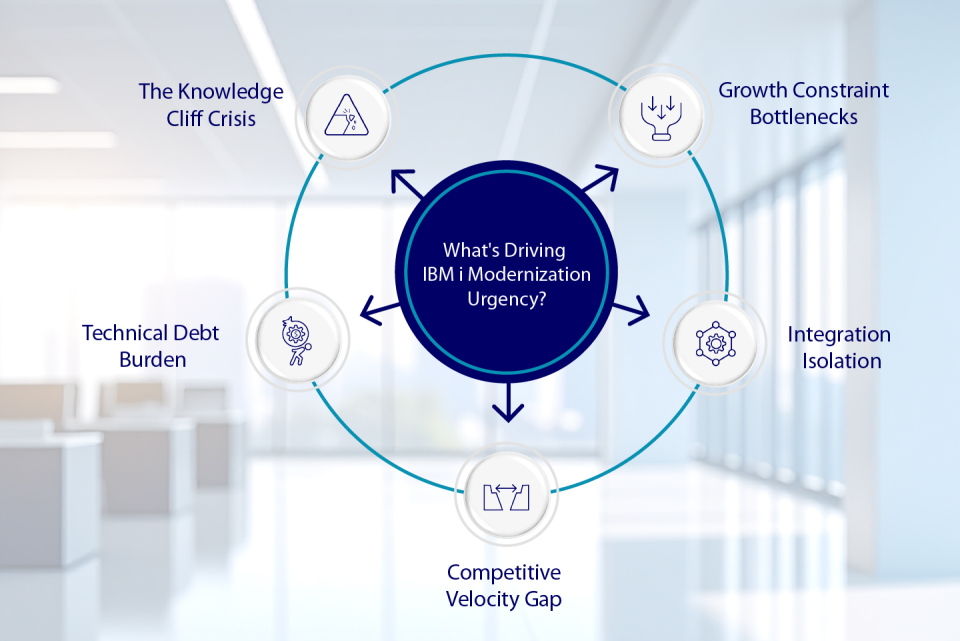
#1 – The Knowledge Cliff Crisis: Losing Critical Knowledge
Impact: Critical | Frequency: 94% of cases
The most pressing threat facing organizations with legacy IBM i (AS/400) environments is the impending loss of institutional knowledge. As the experts who originally built and maintained your RPG and COBOL applications approach retirement, companies risk losing the deep, often undocumented knowledge of their core systems. This creates an IBM i knowledge cliff that can impact support, compliance, and innovation.
Our analysis of modernization projects revealed that nearly every organization faces this reality, with some having as little as two years before critical expertise is gone. This knowledge gap not only creates a skills shortage but also drives up costs as companies struggle to find or retain qualified staff.
While the retirement of key developers is a significant risk, its true business impact emerges when combined with other forces. For example, without this expertise, addressing technical debt becomes nearly impossible, and ambitious growth plans are stalled. The risk of developers retiring is rarely a sufficient AS/400 modernization business case on its own. It becomes a catalyst for modernization when it directly threatens revenue, increases operational costs, or creates a competitive disadvantage.
A clear example of this challenge can be seen with Winsupply’s modernization journey. Winsupply faced the risk of critical knowledge loss as longstanding IT personnel neared retirement. By initiating a comprehensive modernization project, the organization captured and transferred institutional expertise from retiring team members, ensuring business continuity and positioning their systems for ongoing reliability and evolution.
#2 – Growth Constraint Bottlenecks: Scaling Beyond Legacy Systems
Impact: High | Frequency: 78% of cases
Legacy platforms often stand in the way of ambitious expansion goals. Limitations in transaction volumes, database structures, and scalability frequently restrict organizations from capturing new revenue opportunities. Our analysis has shown that these constraints are a common roadblock for businesses aiming to start scaling beyond legacy systems.
Consider the case of a logistics enterprise seeking 150% revenue growth, aiming to jump from $4 billion to $10 billion. Their existing platform’s scalability limitations prevented them from processing the increased transaction volumes required to meet their goals. Addressing these roadblocks through modernization enabled the organization to unlock its growth potential and achieve its ambitious targets.
For more real-world examples of overcoming scalability challenges, explore our Tales of IBM i Modernization eBook, which highlights transformational journeys from constraint to scalability.
#3 – Technical Debt Burden: Freeing IT Budgets for Innovation
Impact: High | Frequency: 71% of cases
IBM i technical debt is another major factor pushing companies to modernize. Fragile or outdated applications often monopolize 60% to 80% of IT budgets, diverting resources from innovation to routine maintenance. This leaves organizations stuck in a cycle of playing catch-up while competitors invest in forward-looking technologies.
Modernization offers a way out. By adopting automated code transformation and modern DevOps practices, companies can reduce recurring costs and free up budgets for strategic initiatives. Lamps Plus provides a clear example of this. By leveraging X-Analysis, they conducted a comprehensive IBM i legacy code cleanup, which streamlined their IT operations and reduced ongoing maintenance costs. This proactive approach not only resolved their technical debt but also positioned the company for scalable growth and improved agility.
💡Read the Full Case Study Here
#4 – Integration Isolation: Breaking Down Data Silos
Impact: Medium | Frequency: 65% of cases
Integration isolation is another key driver for IBM i modernization urgency. Modern business requirements demand real-time connectivity to cloud services, APIs, and third-party platforms. However, legacy architectures often require complex and fragile workarounds for even basic integrations. This isolation traps business data in silos, preventing access to real-time analytics and smarter decision-making.
To bridge the gap between reliable legacy back-ends and agile, interconnected digital ecosystems, modernization is essential. A clear example of this is the Borough of Chambersburg, which modernized its systems with custom web application development to launch a self-service utility billing portal. This initiative improved data flows and empowered customers with seamless self-service access, demonstrating the power of effective legacy integration.
👉 Learn more about their modernization journey here.
#5 – Competitive Velocity Gap: Staying Ahead of Agile Competitors
Impact: Medium | Frequency: 58% of cases
The competitive velocity gap is a growing challenge for organizations with legacy systems. Fresche’s analysis shows that outdated technology often leads to onboarding cycles stretching as long as six months. Meanwhile, competitors with modernized systems can onboard customers in a matter of days or even minutes.
This disparity has a direct impact on customer experience and retention. Businesses stuck with slow processes risk losing customers to faster, more agile competitors. By modernizing their systems, organizations can eliminate bottlenecks, accelerate deployment, and provide the seamless experiences that today’s customers expect.
Addressing this gap is critical to staying relevant and competitive.
What Happens if You Delay IBM i Modernization?
The most common objection to a large modernization project is to do nothing. After all, the system has worked for decades, so why change now? This perspective overlooks the compounding nature of risk. Maintaining the status quo is not a sustainable strategy but rather a deferral of cost and complexity.
The reality is that every year that passes makes IBM i modernization harder and more expensive. We predict that companies initiating modernization after 2027 will face costs 40 to 60% higher due to knowledge scarcity and increased technical complexity.
Some may believe that emerging AI technologies will make it easier for non-RPG developers to maintain legacy code, reducing the urgency. While AI can certainly help understand programs faster, it’s not a silver bullet. It does not solve the underlying issues of a monolithic architecture, technical debt, or the need to understand the entire IBM i ecosystem. Relying on AI as a future fix is a false comfort that delays addressing fundamental business risks.
Having witnessed these projects firsthand, my advice is straightforward: don’t wait for a crisis to force your hand. A reactive modernization project is always more expensive, riskier, and more stressful than a proactive one. Organizations that act now can control their timeline, mitigate risk, and secure their business for the next decade. If you want a deeper breakdown of the financial implications and strategic tradeoffs, we explore them in The Cost of Delaying IBM i Modernization: Benefits, Risks, and ROI.
Take the Next Step with Fresche
Successfully navigating this journey requires a partner with the expertise to bridge the legacy and modern IT landscapes. However, large, risky projects are a legitimate concern, especially for decision-makers whose careers are on the line. Fear of failure often paralyzes progress.
That’s where Fresche’s incremental approach comes in. We specialize in modernizing IBM i environments without disruption. Rather than a massive, high-risk project, we focus on a Modernization-as-a-Service (MaaS) model. This strategy delivers value at each stage and allows you to maintain control.
We often begin with Managed Services to address the immediate risk of developer attrition and to document systems. This establishes a foundation of trust. From there, we can target a strategic application to reimagine a workflow, improve the user experience, or provide new analytics capabilities.
This phased delivery demonstrates ROI, reduces the footprint of your legacy system, and builds momentum for further transformation.
To support your planning, explore these resources for practical guidance on incremental modernization:
- The Do’s and Don’ts of IBM i Modernization: 10 Best Practices for Quick Wins
Read Full Article - Quick Wins with Phased IBM i Modernization: What Teams Can Do Today
Watch On-Demand Webinar
If you’re ready to evaluate your IT strategy or plan your next transformation phase, connect with a Fresche expert for a personalized assessment. Together, we’ll create a phased approach tailored to your unique objectives.