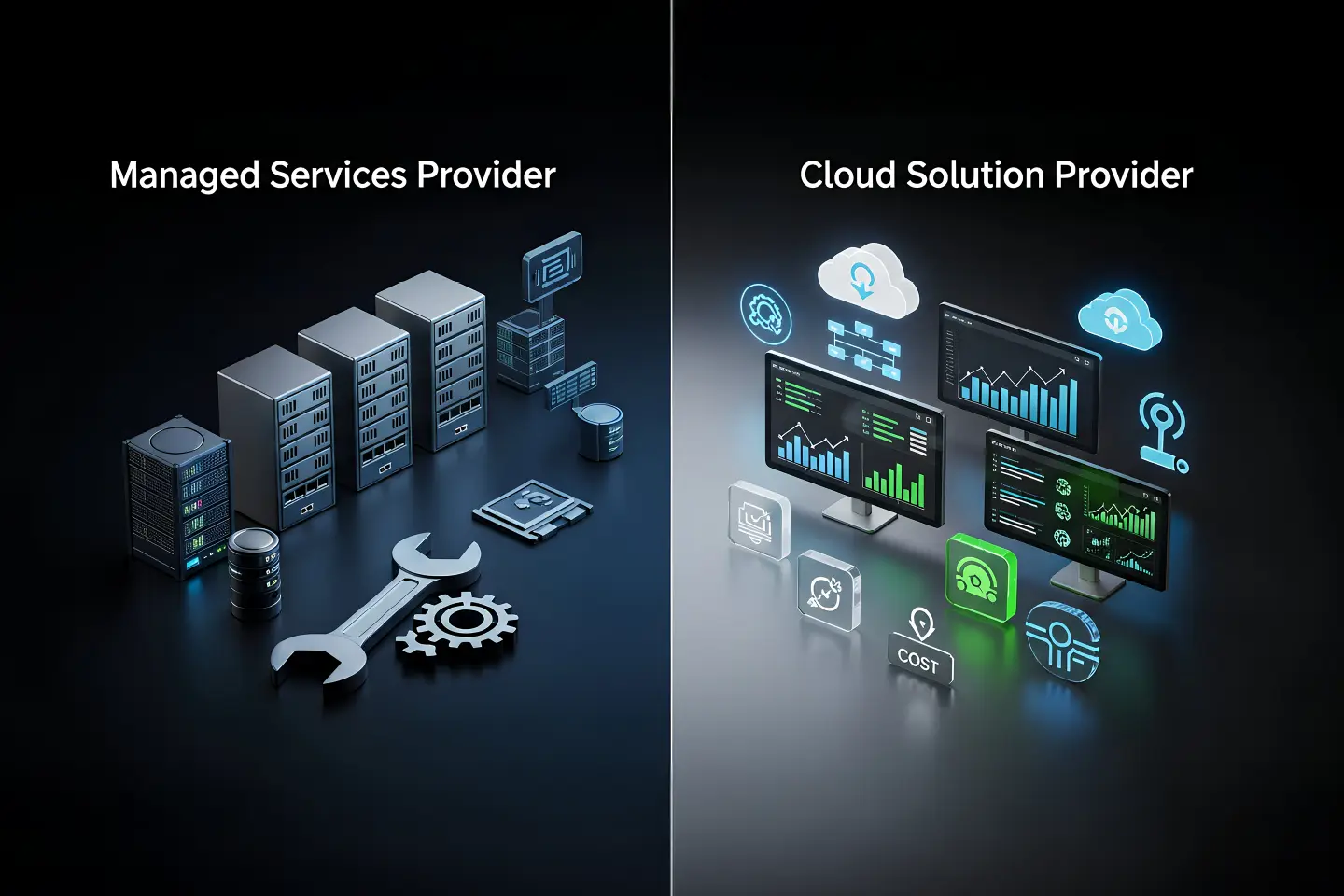

As organizations migrate critical operations to Microsoft cloud platforms, two acronyms dominate the conversation: Managed Services Provider (MSP) and Cloud Solution Provider (CSP). While often used interchangeably, these partners serve fundamentally different purposes.
Confusing the two is one of the most common reasons cloud costs spiral out of control.
For CIOs and IT leaders, understanding the distinction is not just about semantics; it is about financial governance and operational stability. An MSP ensures your lights stay on. A CSP ensures you aren’t paying for electricity you don’t use.
Here is a clear breakdown of the differences, why traditional models often fail, and how a strategic approach to Microsoft cloud services can drive measurable business value.
What is a Managed Services Provider (MSP)?
A Managed Services Provider (MSP) focuses on the operation, support, and stability of your technology. They act as the custodians of your infrastructure, ensuring systems are available, secure, and performing as expected.
Typically, an MSP’s core responsibilities include:
- Infrastructure monitoring and incident response: keeping a vigilant eye on servers and networks to prevent outages.
- Patch management and security operations: applying critical updates to protect against vulnerabilities.
- Backup and disaster recovery: ensuring data integrity and uptime commitments.
- Day-to-day administration: managing user access and troubleshooting issues in both cloud and on-premises environments.
MSPs are measured on stability and responsiveness. Their value is strongest when environments are well-defined and change is strictly controlled.
What is a Cloud Solution Provider (CSP)?
Microsoft’s Enterprise Agreement has historically been the default licensing model for organizations with more than 500 users. While EAs remain suitable for some enterprises, many organizations find that their rigidity can introduce unnecessary costs, limited flexibility, and slower adaptation to changing business needs. For these organizations, there is a more agile alternative.
The Microsoft Cloud Solution Provider (CSP) program allows organizations to purchase Microsoft cloud services such as Microsoft 365, Azure, and platform services without the constraints of an Enterprise Agreement or minimum seat commitments.
More importantly, CSP changes the relationship model. Unlike the transactional nature of EA licensing, the CSP framework is built for ongoing partnership, continuous optimization, and measurable value. When executed properly, CSP offers:
- Microsoft Azure subscriptions
- Microsoft 365 and Dynamics licensing
- Platform services such as Microsoft Fabric and Power BI
- Consumption based services tied to usage
In theory, CSPs are positioned to play a vital governance role. They see usage, licensing patterns, and spend across the entire Microsoft stack. However, in practice, many CSP relationships stop at the billing layer, leaving significant value on the table.
MSP vs. CSP: A Quick Comparison
To visualize the difference, compare the primary roles and incentives of traditional providers against a strategic partner like Fresche.
Feature |
TRaditional Managed Services Provider (MSP) |
Traditional Cloud Solution Provider (CSP) |
Fresche CSP Approach |
| Primary Role |
Operates and supports technology on behalf of the customer. |
Manages how Microsoft cloud services are purchased, licensed, and billed. |
Acts as an extension of your team, accountable beyond renewal cycles. |
| Core Responsibilities |
|
|
|
| Characteristics |
|
Passive billing with lack of continuous insight. |
Proactive identification of cost, licensing, and capacity issues before they impact budgets. |
| Typical Incentives |
Increase operational footprint and maintain stability. |
Grow license counts and consumption. | Maximize client value, not spend; focus on right-sizing and strategic alignment. |
| Best for |
Reliable day-to-day IT operations. |
Ongoing cloud cost optimization, governance, and strategic value. |
Unifying MSP and CSP management for maximum value, cost efficiency, and confidence. |
Where the Traditional CSP Model Breaks Down
The Cloud Solution Provider program was never intended to be a passive resale motion. Yet for many organizations, that is exactly what it has become. Most CSP and MSP relationships fail in one critical area: ongoing cost and platform optimization.
The root cause is often misaligned incentives.
For many partners, CSP is a growth vehicle rather than a governance tool. Managed services teams are incentivized to increase their operational footprint, while CSP partners are incentivized to grow license counts and expand Azure consumption.
When a partner’s margin grows with total Azure spend, there is little motivation to actively reduce consumption, spin down unused resources, or challenge over-provisioning. Optimization runs counter to how the business model is measured.
The Hidden Costs of Passive Management
This misalignment leads to predictable, costly outcomes. Costs grow quietly while visibility declines. Reviews become reactive, often occurring only at renewal time rather than as part of an ongoing operating rhythm.
We see the same behavior repeatedly across mid-market and enterprise customers:
- Environment reviews only occur annually.
- Licensing audits are rare, meaning departed employees retain licenses for months.
- Bundled licenses (like Microsoft 365 E5) are rarely evaluated holistically, leading to overlapping SKUs.
- Project-driven Azure workloads are provisioned quickly but rarely decommissioned.
- Fabric or Power BI capacity is upsized to solve architectural problems rather than compute issues.
In these scenarios, the CSP shifts from a strategic lever into a simple billing mechanism. Customers lose the continuous insight the program was designed to provide, and IT leaders are left explaining budget variances to the board.
How Fresche Approaches CSP Differently
At Fresche, we believe a Cloud Solution Provider must serve as more than a licensing vehicle. We act as an extension of your team with accountability that extends far beyond renewal cycles.
Our CSP engagements are built on active management:
- Continuous Reviews: We conduct regular license and user reviews to remove inactive or departed users immediately, not annually.
- Workload Analysis: We perform ongoing Azure consumption analysis tied to actual workloads, ensuring you pay only for what drives business value.
- Data-Driven Planning: Our Fabric and Power BI capacity reviews are grounded in data modeling and usage patterns.
- Waste Reduction: We provide specific recommendations to reduce waste, rather than simply shifting SKUs.
Through this ongoing engagement, our clients uncover meaningful savings and improved governance. More importantly, they gain confidence that their spend is intentional and defensible.
Why This Matters for Data and AI Platforms
As organizations adopt Microsoft Fabric and Azure AI services, Azure cost optimization becomes inseparable from architecture.
AI workloads introduce usage-based consumption that can be unpredictable. Microsoft Fabric blends analytics, engineering, and BI into a single capacity model. Without active oversight, costs can escalate quickly for reasons that have nothing to do with business value.
A CSP partner who understands data and AI platforms deeply can:
- Prevent over-scaling before it impacts the invoice.
- Separate experimentation from production environments to contain costs.
- Design environments with built-in cost guardrails.
- Help teams mature their platform operations instead of reacting to surprise bills.
This is where the intersection of a Managed Services Provider mindset (operational rigour) and a strategic CSP approach (cost governance) becomes critical.
CSP as a Strategic Control Layer
CSP done right is not about discounts or invoices. It is about control, visibility, and alignment.
If your current partner never proactively recommends reducing spend, retiring resources, or changing architecture, you are not getting a partnership. You are getting a billing intermediary.
Fresche’s CSP program is designed to pair licensing and cloud consumption with real expertise across data, AI, cloud infrastructure, and application platforms. Our goal is simple: ensure your Microsoft investments support how you operate today, while remaining flexible enough to evolve tomorrow.