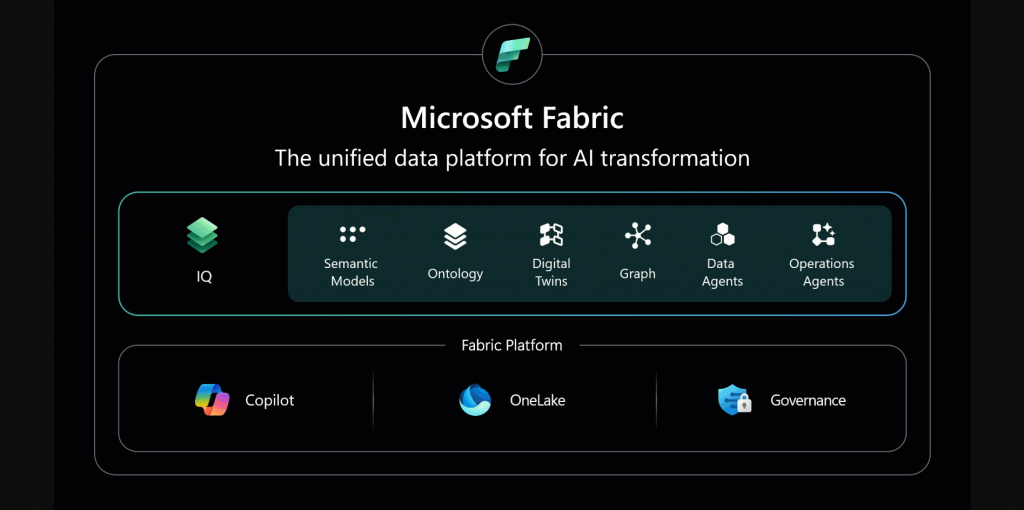
At every Microsoft Data conference, it feels like Microsoft Fabric isn’t just evolving, it’s redefining what it means to be a modern Data & AI Platform. Microsoft Ignite 2025 marked a significant shift, moving away from the idea of a unified data platform to an intelligence platform that simplifies how customers modernize, govern, and operationalize data for analytics and AI.
It’s always difficult to separate the marketing material and hand waving on stage, with the reality on the ground for our enterprise partners. For our customers, this shift to an intelligence platform means their data estate becomes more functional, more connected, and most importantly: more actionable. Instead of spending months stitching together governance models, semantic layers, and AI capabilities, Microsoft Fabric can serve as a foundation that allows achievable AI insights without deep development with secondary SaaS applications or AI Foundry.
The result is a shortened path from raw day to insights, from prototype to protection, making AI more approachable for teams that previously viewed it as too complex or costly to implement.
Fabric Meets AI and Agents
Microsoft Ignite 2025 introduced the idea that Fabric is no longer just a place to store and process data. It is now the core of an intelligence layer that brings together data, semantics, and AI-driven automation. This new layer is powered by Fabric Data Agents and Fabric IQ, which allows AI to understand how a business actually operates instead of working with isolated tables or manually engineered pipelines.
For customers, this evolution means AI can finally operate within the guardrails of enterprise logic. Agents can follow governance rules, respect workspace permissions, and produce insights based on trusted data models. The shift enables use cases that were traditionally expensive or fragile, like automated KPI analysis, contextual reporting, or intelligent monitoring across multiple systems. AI becomes reliable, governed, and embedded into everyday workflows.
1. Fabric Data Agents: From Assistants to Analytical Teammates
Microsoft introduced Fabric Data Agents last year, but at Ignite 2025 they made a clear leap forward. These agents are no longer simple assistants that answer questions by querying data. They now function as intelligent systems capable of:
- Understanding relationships within structured data sets
- Interacting directly with semantic models and governed data assets
- Executing multi-step reasoning over warehouses, lakehouses, and business entities
- Producing insights that are grounded in real data instead of relying solely on retrieval augmented generation
This evolution means agents can behave more like analytical teammates. They can interpret business logic, follow governance rules, and respect permissions across Microsoft Fabric workspaces. These updates move AI agents from an exploratory idea to something organizations can adopt in production for reporting, insights, data quality checks, and operational decision support.
2. Fabric IQ: A Semantic Intelligence Layer
One of the most important shifts is the introduction of Fabric IQ. This layer brings semantic structure and business understanding to the platform. Instead of forcing teams to manage collections of tables and pipelines, Fabric IQ allows organizations to define:
- Business entities such as customers, products, locations, and transactions
- Relationships between those entities
- Metrics, KPIs, and calculations that represent how the business actually operates
This helps unify analytics, operations, and AI reasoning. Instead of agents needing to interpret messy or inconsistent data, they can rely on a shared semantic foundation. It also reduces the amount of engineering effort needed to maintain analytics systems and cuts down on the manual work associated with pipeline management, modeling, and downstream reporting.
With Fabric IQ, the platform becomes more aligned with how business teams think, which also means AI becomes easier to adopt because agents can reason over structured, trusted concepts instead of raw files.
Microsoft Ignite 2025 – Meet Fabric IQ
3. Unified Agent Infrastructure: Connecting Fabric with the Microsoft AI Ecosystem
Ignite 2025 also brought a major step toward unifying how agents are built, deployed, and governed across Microsoft platforms. Fabric now integrates with a broader agent infrastructure that includes:
- Agent 365 for identity, permissioning, monitoring, and lifecycle management of agents
- Shared principles for how agents access data across Microsoft 365, Fabric, Azure, and third-party systems
- A consistent governance and security model so organizations can approve, supervise, and audit agent behavior
This gives enterprises something that has been missing in most AI deployments: an operational framework that treats agents like digital employees with defined scope, accountability, and guardrails.
Microsoft Fabric benefits from this because its data becomes a native, governed input for agents without the need for custom security layers or integration work. It simplifies the move from isolated AI proofs of concept to AI systems that operate within real business workflows.
Combined, these changes reposition Fabric for an AI-first world.
When you combine powerful data agents, a semantic intelligence layer, and a unified agent governance stack, Microsoft Fabric becomes much more than a data platform. It becomes the connective tissue between raw data, business understanding, and AI-driven decision making.
Organizations can move faster, reduce reliance on manual engineering, and deploy agents that actually understand how their business works. For partners advising customers, this opens the door to new modernization conversations, new AI strategy engagements, and entirely new categories of outcomes centered around automation and intelligence.
Why Microsoft Fabric Matters for Your Business
If you are evaluating or working with Microsoft Fabric, or advising clients, these updates represent a strategic inflection point. Data and AI workloads no longer need to be treated as separate initiatives that require parallel teams, tooling, and governance structures.
When Fabric is set up correctly from the start, the same work that enables accurate reporting and trusted analytics also becomes the foundation for AI.
A well-designed semantic layer is the key. By defining business entities, relationships, and metrics inside Fabric, organizations give AI systems a structured, governed understanding of how their business operates. This reduces the amount of custom engineering, prompt shaping, and data preparation typically required for AI projects. Instead of building bespoke pipelines or training models on fragmented datasets, AI agents can rely directly on Fabric’s curated, permission-aware data estate.
The outcome is faster development, lower cost, and far less complexity.
Teams spend more time applying AI and less time preparing for it. Partners benefit as well, because engagements shift away from heavy infrastructure work toward higher-value strategy, enablement, and business transformation. Fabric’s intelligence foundation becomes a force multiplier, allowing AI initiatives to move from pilot to production without the usual friction that slows enterprise adoption.
What You Should Do Next
The journey to making the most of Microsoft Fabric starts with a few critical steps. These are the same steps I recommend to every organization looking to modernize their data and AI strategy:
- Evaluate your data estate readiness: Assess your current infrastructure to ensure your data is clean, connected, and governed. This is the foundation for enabling trusted analytics and AI.
- Define your semantic model and business taxonomy: Build a structured framework by defining business entities, relationships, and metrics. This will align your data with how your business operates and reduce the need for custom engineering.
- Pilot Fabric Data Agents for high-value use cases: Start small by testing agents on specific, impactful use cases like KPI analysis or intelligent monitoring. This will help you demonstrate value quickly and build confidence in the platform.
- Bake in governance from day one: Establish clear rules for data access, permissions, and compliance to ensure AI operates within trusted guardrails.
- Start positioning as a data and AI transformation partner: Whether you’re working internally or advising clients, focus on enabling strategic outcomes and driving business transformation through AI-powered insights.
By following these steps, you’ll set your organization up for success and create a strong foundation for integrating AI into your operations.
Final Thought: Fabric is Now the Foundation for the AI-First Enterprise
Microsoft Ignite 2025 did more than add features. It reimagined what Microsoft Fabric is and what it can become. By embedding semantics, agent-ready data reasoning, and unified governance into Fabric, Microsoft is offering a scalable way for businesses to integrate AI deeply into operations without sacrificing control.
If you’re interested in learning more about Microsoft Fabric, here’s how to get started:
- Schedule a consultation: Start your AI journey with expert guidance.
- Pilot a use case: Explore Fabric Data Agents in action.
- Build your roadmap: Plan your path to AI success.